Showing posts with label near future science fiction. Show all posts

Monday, October 14, 2024

Interview with Keith McWalter, author of Lifers


Today it gives the Speculative Fiction Showcase great pleasure to interview Keith McWalter, whose novel Lifers has its debut on October 15, 2024.

What prompted you to write about a near-future in which longevity – and immortality - becomes common?

As I’ve grown older, I’ve naturally become more preoccupied with the idea of living a long and healthy life, and I’ve read widely in nonfiction accounts of longevity science and its practical applications.

Two things struck me about most discussions of longevity enhancement: increased longevity tends to be viewed as a luxury product for the rich and the few; and no one discusses the economic and social stresses that a radically longer (even if healthy) lifespan would impose on individuals, on families, and on society at large.

I wrote Lifers to dramatize those unspoken implications, and to examine ageism from a different perspective in which extreme longevity becomes commonplace and there are so many super-aged individuals that they become a problem – and a force – that must be reckoned with.

Who are the “Lifers” of the title?

“Lifers” is a colloquialism that comes into use in the mid-twenty-first century, referring to the first generation to show signs of infection with an engineered longevity protein called the “Methuselah genome.” In this demographic sense it means those born from 1946 to 1964 (basically, the boomer generation) and still living at least one hundred years later.

But it also comes to be used as a political label to refer to members of the “Lifer Liberation Front,” who resist governmental attempts to “manage” the explosion of longevity and its consequences, and in a spiritual sense to refer to those who choose to live on indefinitely rather than take a slow-acting suicide drug that comes into wide usage. 

Tell us something about the non-fiction books that inspired you to write Lifers: Chip Walter’s Immortality, Inc. and Andrew Steele’s Ageless. 

Immortality, Inc., was one of the main inspirations for Lifers. Chip Walter is an experienced journalist and former CNN bureau chief, and his group portrait of the billionaires and bio-entrepreneurs who populate Silicon Valley’s super-longevity ecosystem begged for a fictional portrayal. So for Lifers I created Gustav Zinnemann, a Silicon Valley microbiologist and serial entrepreneur who designs the “Methuselah genome” and becomes a man on the run from his greatest triumph.

Andrew Steele’s Ageless is a more scholarly work, full of the sort of deep, technical information about how serious, non-profit-driven science is tackling the problem of aging by treating it as a disease in itself, and not a necessary result of living. It opened my eyes to the new discipline of computational biology, which in turn suggested that, in the near future, there might be a direct interface between computer algorithms and human proteins that could alter cellular mechanics and perhaps let us literally reprogram our cells. 

How much have you been influenced by contemporary ageism and what used to be called “the Generation Gap”?

Don’t get me going. I very much hope that Lifers is seen as an anti-ageist screed and a satire on the absurdities of our age-stratified society. I think all of us in western culture are so steeped in ageism, like fish in water, that we’re not even aware of it, though when you grow older, as we all must and I have (I hesitate even to say that for the usual ageist reasons), you can’t avoid feeling its effects – which are, to be specific, ostracism, condescension, progressive invisibility, forced irrelevance, and isolation, to name a few. The very act of writing a novel in one’s seventies is presumed to be such an invitation for rejection that the only rational response is pity. Nonetheless, I’ve written one, and at its heart it’s all about contemporary ageism.

As for “the Generation Gap,” there are so many layers of labelled generations these days (X, Y, Z, Alpha, etc.) that the original generation gap (between the boomer generation and their parents) seems, in retrospect, not much of a gap at all, and was mainly based on just two things: music, and the war in Vietnam. Meanwhile, my daughter can’t understand half of what my grandsons are saying when they’re “mewing” and “rizzing” their way through TikTok. 

Are you aware of the less-well-known episode in Gulliver’s Travels, by Irish writer and satirist Jonathan Swift, which deals with immortality?

I confess I had forgotten about Gulliver’s visit with the immortal “Struldbruggs,” but maybe I remembered that episode subconsciously, because my Lifers, like the Struldbruggs, do continue to age slowly even though they don’t die and, like Swift’s immortals, are deprived of various legal and constitutional rights as they grow older. Swift’s dystopian view of super-longevity has many resonances in Lifers, and I’m grateful to be reminded of them! 

How does Lifers fit into contemporary genres? Would you call it science fiction or satire, or both? 

It’s definitely a blend of both, and the science is only barely fictional. The background of the longevity breakthrough described in the book is based on actual science, and refers to real people, such as the maverick gerontologist Aubrey de Grey, who was an early trailblazer in conceptualizing aging as a disease that can and should be cured. So it’s only science fiction in the sense that the science hasn’t quite gotten there yet, but it’s coming fast. 

There’s a lot of satire in Lifers, particularly around contemporary politics and corporate life, but I hope it’s in service to the story rather than the other way around.  I grew up reading a generation of sci-fi writers who used the genre to satirize social foibles and injustices – authors like Isaac Asimov, Ray Bradbury, and Philip K. Dick. Sci-fi as a genre has since taken a much more escapist turn, but I wanted Lifers to hark back to what you might call social sci-fi, and maybe generate some serious discussion about how we regard aging, how we avoid the reality of our mortality, and how we treat the aged in real life. 

You focus on three strong women protagonists: an ex-CIA microbiologist, a Washington insider turned advocate for “grey rights,” and a philosopher of death and dying. What can you tell us about these women and their role in the story?


Marion Altman is the most prominent of the women protagonists. She’s a former Washington insider and heiress to a real estate fortune who fears for the future of her and her husband Dan’s generation of boomers as they age into their second century, and sets out to create a sanctuary for Lifers deep in the Colorado mountains. She’s motivated by a lifetime of experience of being underestimated.

Adele Pritchard is a biowarfare specialist formerly with the CIA and the National Security Council, now well into her second century and leader of an ad hoc global organization dedicated to stopping the spread of the longevity plague. Hidden in her past is the infant daughter she gave up for adoption in the wake of an affair with her then White House colleague – and Marion’s husband – Dan Altman. Adele and Marion must overcome this fraught personal history in order to join forces in defense of Lifers.

Then there’s Claire Landess, who is Marion and Dan’s granddaughter. She’s a feminist philosopher and author of popular books on death and dying who believes that extreme longevity is objectionable on purely moral grounds and vaults to fame and political power with the advent of the longevity plague. As a spokesperson of an anti-Lifer backlash and head of the new federal “Department of Longevity Management,” she becomes the reluctant nemesis of her grandmother Marion’s movement.

What if any challenges are there for you as a man in writing female POV characters? 

For whatever reason, perhaps having to do with the influence of my super-competent mother and my independently-minded spouse, I find that writing from a female point of view comes easily. The challenge, of course, is not to presume too much understanding of women’s unique experience, and to maintain a stance of humble empathy as a writer. 

The presidential election in the States until recently featured two candidates who were both elderly. There are similar statesmen across the world. What do you think of the idea of a gerontocracy and has it influenced your writing?

What an interesting question.  I think our current gerontocracy is a demographic accident, the confluence of the huge post-war baby boom population bulge, the politically turbulent Sixties that were formative years for those now in their seventies and eighties, and advances in medicine and nutrition that make active lives in later years possible. I don’t think this will last, and that after the boomers die off (the first wave of which we’re now seeing), political leadership will gravitate back toward a relatively younger age group.

Regarding my writing, one of the main themes I hope to get across in Lifers is the perniciousness of our unconscious ageism, how we pigeonhole people according to their ages and waste their talents and wisdom as they grow older. A related, crucial point is that people age at vastly different rates and the physical and mental abilities of one eighty-year-old are often completely different from those of another. 

Can you tell us about Taubin, one of your characters who suffers from a condition known as progeria? What is progeria and how does it affect him?

Thank you for asking about Taubin.  I found writing from inside his head and his dialogues with his elders to be a joy, one that came very easily. He’s a neurodivergent (Asperger’s, OCD) social media programmer in his 30s, employed by a biotech company to persuade Lifers to want to end their lives with the company’s slow-acting suicide drug. He’s an expert at creating influencing algorithms that operate in “chipspace,” the realm of distributed neural headchip networks that has replaced the internet.

He eventually contracts a variant of the Methuselah virus that accelerates his aging. In real life, progeria (sometimes called Hutchins0n-Guilford syndrome) is caused by a mutation of the cellular protein lamin-A, which regulates the integrity of the nucleus. The result is accelerated aging that starts in infancy and, tragically, radically shortens lives.

In the book, Taubin embodies two important themes: he’s deeply influenced by and loving toward his doting grandparents, who raised him, so he represents the power of cross-generational bonding which, in the book, quite literally changes the world. And because of his artificially-induced progeria, he’s able to join them in old age, and represents his grandmother’s dream of heaven as a place where everyone is the same age, and age itself becomes meaningless.

You are in your seventies. How much has your personal experience influenced the writing of the novel? 

I’m quite sure I would not have written Lifers ten years ago. It’s the direct product of turning seventy and beginning to think seriously about the remainder of my life, how I want to live it and will be permitted to live it – and about what life would be like if a whole lot of us had the opportunity to “live on,” as they say in the book.

I’ve written an entire essay on the subject of entering my seventies, but suffice it to say that the only proper response to having arrived at this point in a vastly lucky life is sheer gratitude. And I’m deeply, continuously grateful. I’m physically fit, surrounded by remarkable friends and family, and blessed with a loving wife who makes every day a gift. But I’m also greedy. I want more and more of the lucky life I’m living, not less and less. Not only can I do the math, I resent it. I regret not having felt the passage of time more acutely, so that my aging from year to year might have been experienced more fully and honestly, and my age now really would be, as the sweet old lie has it, “just a number.”

Aging is, at bottom, the long foreshadowing of mortality, and that must be the deepest, most unspeakable reason for the stigma we assign to old age. In the book, the philosopher Claire Landess is the spokesperson for acceptance of our death as not only a given, but the morally proper outcome for all of us. I’m not quite there yet, but I want to believe her.

One could argue that the elderly (and their carers) are already poorly treated by society. How much is the future envisaged in your novel already with us?

This is where satire and painful current reality meet. The “sequestration camps” that in the book are set up to house the increasing masses of the old are only a short step from the retirement homes and extended care facilities we accept as normal today. The systematic curtailment of the constitutional rights of the aged depicted in the book are not far different from the curtailment of rights that some political figures would like to enact on all of us today, and that are informally but forcibly imposed on the very old. The overt antagonism exhibited by the “doublers” in the book (those still in their double-digits) toward the “triplers” is foreshadowed in the dismissal of the old as useless and irrelevant that our current society routinely visits on its elders. Need I go on? 

Tell us something about your first novel, When We Were All Still Alive, published in 2021. How does it differ from Lifers and how has your writing process changed?

Lifers is very different in that my first novel was self-consciously “literary,” whereas this new one is more of a thoughtful entertainment. WWWASA was an attempt to emulate a kind of fiction that, when I was a young, was more concerned with intimate relationships and precise description of those relationships than with complex plotlines or exotic circumstances (think Updike, Salter, Evan S. Connell). It’s about a man in late middle age who loses the person dearest to him – his wife – and what that does to him, how it changes his understanding of his past and his future, and his relationships with those around him.

Its connection to Lifers is that it’s also about how we avoid but ultimately have to deal with the fact of our mortality, and about the unfairnesses and consolations of growing older.

Different though that first novel was, I don’t think my writing process has changed much. I write intermittently, spontaneously, and from the gut, in spurts that can last from a few minutes to a few hours, usually in the afternoon. I have a general sense of the story arc, and a clear sense of the major characters, but I follow that arc very organically and it usually takes some unexpected (even to me) turns. I do not outline in detail, though for Lifers I had to create a very detailed timeline with main events and each character’s age at various points, and consulted it constantly.

What are you working on now?

Apart from a lot of blog posting on the current political situation (in Mortal Coil), I’m working on a sequel to my first novel and hope to have a draft done by year-end.

I’m also beginning to think about a sequel for Lifers that would take off from the book’s conclusion, where a very specific form of time travel – actually, collective memory travel – becomes  possible. I want to depart from the current fabulist trend where time travel just “is” – it’s an unexamined premise, not a plausible process (I’m thinking of The Ministry of Time and Sea of Tranquility).  The whole trope of time travel has become a rather tedious cliché and needs some new life injected into it. So that’s my next mission: make time travel believable again.

Simon and Schuster | Amazon | Bookshop


About Keith McWalter:


Keith McWalter’s first novel, When We Were All Still Alive, was published in 2021. His essays have appeared in The New York Times, The New York Times Magazine, and the San Francisco Chronicle. He’s the author of two blogs, Mortal Coil and Spoiled Guest, which present his essays and travel pieces to a loyal online following. A collection of his essays, No One Else Will Tell You: Letters from a Bi-Coastal Father, won a Writer’s Digest Award for nonfiction. 

Keith is a graduate of Columbia Law School and earned a BA in English Literature from Denison University. He lives with his wife, Courtney, in Granville, Ohio, and Sanibel, Florida.


Website | Facebook | Twitter | Instagram


Thursday, September 29, 2022

Indie Speculative Fiction of the Month for September 2022


Indie Speculative Fiction of the Month
It’s that time of the month again, time for “Indie Speculative Fiction of the Month”.

So what is “Indie Speculative Fiction of the Month”? It’s a round-up of speculative fiction by indie and small press authors newly published this month, though some August books I missed the last time around snuck in as well. The books are arranged in alphabetical order by author. So far, most links only go to Amazon.com, though I may add other retailers for future editions.

Once again, we have new releases covering the whole broad spectrum of speculative fiction. This month, we have urban fantasy, epic fantasy, cozy fantasy, paranormal mystery, planetary romance, space opera, military science fiction, science fiction romance, near future science fiction romance, weird western, horror, speculative poetry, vampires, werewolves, wizards, dragons, aliens, space cadets, cursed thieves, blood curses, artificial intelligence, magical tea shops, talking cats, crime-busting witches, intergalactic playboys and much more.

As always, I know the authors at least vaguely, but I haven’t read all of the books, so Caveat emptor.

And now on to the books without further ado:

Nightswept by Odette C. BellNightswept Episode 1 by Odette C. Bell:

They say night will always lift. Day must come. But when the light threatens to leave the Coalition for good, only two cadets will stand in its way.

When Samantha, a promising cadet with a chip on her shoulder, barely survives a cataclysmic attack on an observation world, it takes her memories and leaves her with an ancient gift. A force now resides in her mind, and it has removed all her recollections. She can only recall one memory – and one man – Bastien Vanguard, the galaxy’s richest playboy and her greatest enemy.

Bastien can’t stand her, but only he can unlock her memories and save the Coalition before it’s too late. For forces align to tear it down once and for all. Can two enemies come together to save the Milky Way, or will they tear each other apart?

….

Nightswept follows a playboy and an amnesiac cadet fighting to save the universe from darkness. If you love your space operas with action, heart, and a splash of romance, grab Nightswept Episode One today and soar free with an Odette C. Bell series.

Nightswept is the 19th Galactic Coalition Academy series. A sprawling, epic, and exciting sci-fi world where cadets become heroes and hearts are always won, each series can be read separately, so plunge in today.

Star's Guardian by Odette C. BellStar's Guardian by Odette C. Bell:

To protect, is to change the course of history. Fail, though, and you’ll fall.

Grace Smith is about to fall, and there’s nothing that can stop her. She was destined to lose the sacred energy pumping in her veins since birth. The multiverse has always had a plan for her, and now that dark plan unfolds, one dead body at a time.

Grace is used to running from the dark forces hell-bent on murdering her, and she’s good at it. Then she runs into the one man she can’t escape. Alex Round, Supreme Outer Guardian. When he picks her up on a backwater planet by accident, he thinks she’s a pointless distraction. Then hell unravels, and the fabric of reality fractures with it. At its heart sits the one woman he must now protect, no matter what.

Can someone who has run her whole life stop still long enough to accept the help of the only man who can save her? Or will she tumble into the arms or danger and take the rest of the multiverse with her?

…

Star’s Guardian follows a runaway and a lieutenant fighting through secrets to save a lost universe. If you love your space operas with action, heart, and a splash of romance, grab Star’s Guardian Book One today and soar free with an Odette C. Bell series.

Tales from a Magical Teashop by Casey BlairTales from a Magical Teashop by Casey Blair:

Add a dash of joy and imagination to your day with tales of a magical tea that summons cats to snuggle or enables its recipients to exhale sparkles, hilarious combat with aggressive fantasy ingredients while others turn invisible out of shyness, and the day-to-day management of a shop dealing in the unexpected. These are quick stories ranging from silly to bittersweet that can be read as you wait for your tea kettle to boil.

Tales from a Magical Teashop is a stand-alone short story collection set in the world of Tea Princess Chronicles that functions as an introduction to the series with hidden gems for those who’ve read it, featuring scenes set in a shop serving teas made from magical ingredients as well as bonus scenes from the perspectives of fan-favorite characters.

Brew up a cup of tea, and enjoy a little interlude away at a magical teashop!

Light-hearted, comforting, and satisfying, brighten your day with a collection of magical teashop stories from the world of the cozy fantasy series Tea Princess Chronicles.

Queer Weird West Tales, edited by Julie BozzaQueer Weird West Tales, edited by Julie Bozza:

Frontiers have always attracted the Other - where they find that the Other is always already there. These 22 stories explore what happens when queer characters encounter weirdness on the edge of the worlds they know.

Authors include: Julie Bozza, J.A. Bryson, Dannye Chase, S.E. Denton, Miguel Flores, Adele Gardner, Roy Gray, KC Grifant, Peter Hackney, Bryn Hammond, Narrelle M Harris, Justin Warren Jackson, Toshiya Kamei, Catherine Lundoff, Bunny McFadden, Angus McIntyre, Atlin Merrick, Eleanor Musgrove, Jennifer Lee Rossman, Lauren Scharhag, Sara L. Uckelman, and Dawn Vogel.

United We Kill by Jonathan P. Brazee and J.N. ChaneyUnited We Kill by Jonathan P. Brazee and J.N. Chaney:

Humankind is under the gravest threat in its history.

The enemy Naxli keep advancing, taking humans prisoner and destroying human worlds. But this isn’t the Naxli’s first rodeo, and humanity is not alone.

Other races have suffered at the hands of the enemy, and they’ve proposed that humanity join them and present a united front to defeat the Naxli once and for all.

The Congress of Humanity deploys the First Human Expeditionary Brigade to join with the alien military to take the fight to the Naxli. But with seventeen known “allies,” all with different goals and perspectives, how can they form a unified, integrated fighting force? It’s been hard enough for humans to cooperate throughout history, and now the problem has just logarithmically increased.

Still, a mission is a mission, and Gunnery Sergeant Reverent Pelletier, Perseus Union Marine Corps, is going to do what he can to create an effective fighting unit, even if he has to beat in some alien heads to get it done.

Orbs of Wisdom by Lindsay BurokerOrbs of Wisdom by Lindsay Buroker:

With his mother’s life at stake and the entire world threatened by powerful dragons, the sand in the hour glass is running out for Jak Freedar. He and his allies must find the ancient Orbs of Wisdom and hope they hold the solutions to the problems plaguing humanity and the dragons before it’s too late.

This is the final installment in the Dragon Gate saga!

Mark of the Fool by J.M. ClarkeMark of the Fool by J.M. Clarke:

The gods chose him. He said no.

After his parents died, Alex Roth had one desire: become a wizard. Through hard work, he was accepted into the University of Generasi, the world’s greatest academy of wizardry...

Fate, however, had other plans.

On his eighteenth birthday, he is Marked by prophecy as one of his kingdom’s five Heroes, chosen to fight the Ravener, his land’s great enemy. But his brand is 'The Fool'. Worst of the marks.

Rather than die or serve other Heroes like past Fools, he takes a stand, rejects divine decree…and leaves. With his little sister, his childhood friend, and her cerberus, Alex flees for the university, hoping to research the mystery of the Ravener. He’ll make lifelong friends, learn magic from mad wizards, practice alchemy, fight mana vampires and try to pay tuition.

There’s one small problem. The Mark insists on preventing the Fool from learning and casting spells, while enhancing skills outside of divinity, combat, and spellcraft…

…that is, unless he learns to exploit the hell out of it.

Blood Curse by Rachel FordBlood Curse by Rachel Ford:

A terrible curse. A dangerous weapon. An impossible mystery.

With all the residents of Little Eerie turned to goblins by an ancient blood curse, Apprentice Wizard Idun Wintermoon and sellsword Liss Forlatt are in a race against time to undo the curse before goblin hunters show up and kill the hapless villagers.

To unravel the secret of the blood curse, they’re going to need to get their hands on the blood of a royal. A present day, very much alive royal.

And it just might be easier to pull dragon teeth.

Older, Wiser, Witchier by Lily Harper HartOlder, Wiser, Witchier by Lily Harper Hart:

Four women. Four great loves. One great partnership.

It’s been years since Ivy Morgan, Harper Harlow, Maddie Graves, and Rowan Gray married the loves of their lives and decided to settle down. Since that time, they’ve joined together to form a fearsome magical quartet. The plan was to stand with one another. Now that plan is being put to the test.

While out morel hunting with her brother, daughter, and nephews, Ivy stumbles across a body, a ritual dagger causing her to fear they’re dealing with something more dangerous than a normal human. Right away, she calls for reinforcements from her magical friends…and they come running.

Ivy’s magic has grown, and she’s much stronger than she used to be. That doesn’t mean she’s ready for what’s coming, especially when it becomes apparent that her daughter might be following in her mother’s footsteps, and being drawn into a dangerous world she doesn’t understand.

A local real estate developer is dead, his wife is missing, and there’s a random ghost hanging around stirring up trouble. Ivy has her hands full, and things are about to get worse.

Magic is might, and this particular foursome is ready. What if they’re not strong enough to fight off a new threat, however? What will it mean for them as a group?

They’re about to find out, and the answer might be more than they can bear.

Note: This series follows the events of the Ivy Morgan, Harper Harlow, Rowan Gray, and Maddie Graves series. It's set seven years after the events of those series. You do no need to read those series, but if you want more of the characters, that's where you can find them.

Game of Crones by Amanda M. LeeGame of Crones by Amanda M. Lee:

Scout Randall thought killing the master vampire threatening those she loved would make everybody safe. She was wrong.

One dying utterance changed everything.

Yolanda Stratton haunts Hawthorne Hollow like an oily shadow of death. Gunner, the son she tried to kill, tries to pretend that he doesn’t care that she might have answers. He’s not fooling anybody. Graham, the husband who wishes he would’ve killed her twenty years before, is resigned to the games she will play. And Scout? She’s ready to face off with the face of abject evil, even if it comes at a cost.

Just who will be paying that price, however?

Yolanda won’t explain why the lone zombie that appeared behind the Rusty Cauldron boasted the same symbol she had branded into her shoulder years before. She won’t explain why the past is playing so heavily into the present. She definitely won’t explain why the new witch in town is after Scout…and isn’t afraid to play dirty to end her life.

Scout is a witch with a plan but outthinking an enemy she doesn’t understand could be the end of her.

There’s a whisper on the wind…and it speaks of death. Who will fall?

Moral Code by Ross and Lois MelbourneMoral Code by Lois and Ross Melbourne:

Dr. Keira Stetson has two passions: ethical artificial intelligence—AI with a conscience—and creating technology that improves children’s lives. Trapped in an earthquake-flattened building with a half-dozen panicked five-year-olds, she fears the worst. When billionaire Roy Brandt leverages his mysterious nanite technology to rescue them, she’s both grateful and intrigued.

Impressed by his prototype technology but alarmed at its potential for exploitation, Keira merges her company with Brandt’s. The merger gives Keira access to much-needed funds for the development of her own tech, and access to Brandt’s powerful minuscule robots. In turn, she and her AI assistant, Elly, embed Keira’s trademark Moral Operating System in Brandt’s nanite SmartDust to rein in its power.

But Brandt’s technology has been kept secret for a reason. Though he’s adamant about using the Dust to improve life, not destroy it, corporate raiders and the military have other ideas. They want to weaponize Brandt’s nanites. Suddenly, everything Keira has worked for is in jeopardy. Exposed to the worst humanity has to offer, she and Elly must fight to use this newfound tech for good and keep it out of the wrong hands…before it’s too late.

Spacer's Bet by Bonnie MilaniSpacer's Bet by Bonnie Milani:

The attack came out of nowhere. Suddenly a hunting pack, flashing Lupan IDs, dropped out of Jump to fire on the unarmed ore hauler Shojai.

Isfahan "Iz" Hauler Shojai had only an instant to wonder why before the attackers’ guns ripped open Shojai’s cargo bay.

The cargo bay where her ditzy younger brother Kansas was working. The bay whose crew was sucked out into the void. Like herself, Kansas was genetically engineered to survive vacuum. But his protective shell couldn’t hold forever. Battling time and the chaos of a wounded ship, Iz launched herself into the vacuum of the gutted hold to rescue her brother.

Badly damaged Shojai limps into RockPort only to discover that the port is now under the ‘protection’ of Moscow, a woman whose laws are as harsh as the blue ice of her liege world, Streiker. She demands all fees up front. Worse, the voices Kansas ‘hears in his head’ have him spouting a language he doesn’t even speak. But Moscow does.

Already fearing repercussions, Iz drags Kansas away from a dockside murder. But she soon learns that there is far more at stake than just their own lives. They must get to the near-mythical world of Earth or risk the destruction of the human Commonwealth itself.

It doesn’t help that Moscow’s cat attaches itself to Kansas. Especially because the cat seems to have an agenda of its own…

West of Hell: Weird Western Horror StoriesWest of Hell: Weird Western Horror Stories by James A. Moore:

Want to go on a Western Adventure?
Join three highly talented authors on a thrilling journey into the past that’s perfect for readers of Western thrillers, horror, mystery, fantasy, and of course the supernatural.

DEAD MEN by James A. Moore: And the Dead shall rise. Jonathan Crowley is having a problem with dead men. They just keep getting back on their feet. From the ghost dancers at a strange burial site to the corpse of a man he literally just killed, the dead refuse to lay down and die, and now it's up to Crowley and his traveling companion Lucas Slate to try to figure out why the dead are restless and determined to kill whatever crosses their paths.

THE TRICKSTER OF PARADISE by R.B. Wood: Never trust a cave painting with an agenda.
In the old west, the people of Paradise live in harmony with the local Sioux tribe until the U. S. Army arrives with false accusations and their deeply rooted prejudices. While the strange newcomer known as “Mortimer” watches; a sixteen year old boy and an ancient legend must come together to fight the invaders, save the town and win the day. Can the desires of an ancient legend and the wishes of a young man survive the encounter with Death watching their every move?

LAST SUNSET OF A DYING AGE by Michael Burke: Ibuki Shibuya is a disgraced samurai, a fugitive from the vengeance of his former master. His flight leads him to the American Southwest where he discovers a mutilated body in the Arizona desert. He eventually finds himself in Copper City, a frontier town plagued by a series of grisly murders.
A motley cast of characters populate the town and Ibuki becomes embroiled in affairs both mundane and extraordinary as he resolves to assist the sheriff in solving the strange murders. Perhaps he will even meet the honorable end he seeks in doing so. All the while, a strange man, dressed in black, who knows more than he says, lurks outside of Copper City.
Events come to a head when the truth is laid bare. Ibuki, along with both friends and foes, learns that not all remnants of a dying age have given way to progress.

Crystal Lake’s Dark Tide series will continue soon with more tales of Mystery Thrillers and Horror Books, including themes of more Weird Western, Sherlock Holmes, Grief Horror, Body Horror, Halloween, Space Horror, Mystery fiction, and Psychological Thriller books.

The Cursebound Thief by Megan O'RussellThe Cursebound Thief by Megan O'Russell

The world wants a hero. The curse needs a thief.

The party of the decade stands between Jerek Holden and saving the people he would do anything to protect. After twelve years, he’s finally found a way to break the curse that ripped all magic from the world and destroyed the peace that took generations to build. All he needs is one, simple artifact. But he can’t steal the heliostone alone.

A girl with a soul of fire.
A vampire bound by a vow.
A werewolf bent on revenge.
A knight torn between honor and duty.
A hacker to keep them all alive.

The fate of magic lies in their hands?if they can survive long enough to pull off the heist of the century.

The Purpose of Reality: LunarThe Purpose of Reality: Lunar by Steve Simpson:

Steve Simpson's remarkable collection of poetry and illustrations is dream-like, playful and wildly inventive. Here is a selection of the beings within:

The detective, who carelessly morphs into birds and insects, and cannot choose between brooding and moping, until a stylish grayscale client with retrolescent highlights appears.

Proteus, Homo Sapiens Beta, who discovered fire and put it out, who created a rudimentary encyclopedia that he pedaled across Gondwanaland on weekends.

Millie, the intrepid librarian, unperturbed by the Dark Solarian or the fearsome kilowasp, who insists that her underlings pay for bibliotactical losses.

The adorable Deija Vitro, Martian Princess of Glass, whose fans line the streets waving Windex spray. Wollongong will never be the same, because her armies have razed it to the ground. "No one will miss it," she reassured an infatuated follower.

The Purpose of Reality: Solar by Steve SimpsonThe Purpose of Reality: Solar by Steve Simpson:

Steve Simpson's mesmerizing collection of short fiction and illustrations is surreal and wildly imaginative, with touches of playfulness throughout. Here is a selection of the beings within:

At Claire's school, the walls were cardboard, and her chain-smoking math teacher never allowed numbers to be mentioned. He used a drawing of a press to flatten slices of air into tissue paper for kites, and he was Claire's favorite, because all the other teachers were ghosts. One day, with a little pasta and a little mambo, everything changed.

The negentropy wars didn't end the world, there were survivors, and in Santarém, the gringo electrician needed medicine to save his daughter's life. To get it, he had to cross the Amazon River, where the Negentropy Horizon divided Brazil. The locals believed you could look across the river and see directly into hell. The electrician wasn't superstitious, but he decided netting was a good idea, to keep the insects off.

Aldona worked in the Damasco Auto scrapyard, and when the electromagnet on the crane burned out and dropped the blue Passat, no one saw the electric-winged shape that had been trapped by the magnet. After all, there was nothing to be concerned about: the alien space fleet had been driven away by the earth's nuclear defenses.

Remnant Faction by Glynn StewartRemnant Faction by Glynn Stewart:

It is the first and final duty of any warship to put herself between the innocent... and the enemy.

Henry Wong and Sylvia Todorovich have gathered the interstellar powers of the Ra Sector into a tentative alliance—an alliance that is tested by the return of the Sector’s former rulers: the Kenmiri Remnant.

The Sector’s only hope of withstanding a genocidal faction of the Kenmiri is the Twelfth Fleet of the United Planets Alliance. But when Wong’s scouting flotilla collides with the Kenmiri, he discovers they now have a weapon that could easily destroy Twelfth Fleet.

Wong and Todorovich are stranded on the wrong side of a world the Remnant have burned, and they only have one way to meet their allies before it’s too late.

If Henry Wong is to save his people and his allies, he must take his ship on a deadly run into the hostile star systems of the Kenmiri Remnant: the very species he doomed to a slow death.

The Gods Awoke by Marie VibbertThe Gods Awoke by Marie Vibbert:

If the Gods were real, could you believe?

Hitra, high priestess of Revestre, already has enough on her hands: political upheaval, a distractingly attractive male servant, and an upcoming harvest festival. But when a column of flame from the heavens sends a city into tumult, it upends more than just her schedule. Now, Hitra must deal with a religious schism, ethnic strife…and a God growing out of control.

"An innovative slant on a fantastic religion, its worshippers and divinities!
~Mary A. Turzillo, Cosmic Cats and Bonsai"

"Even in a conflict on the scale of Gods, Vibbert masters the art of making small things matter."
~Lorelei Esther, illustrator, The Kitra Saga

"Creative, quirky, fun, Vibbert delivers a wild new take on divine gods and their petty squabbles in The Gods Awoke!"
~Tobias S. Buckell, Crystal Rain

Bad Tidings from Queen Sophie by Danielle WilliamsBad Tidings from Queen Sophie by Danielle Williams:

As heard on the NoSleep Podcast

When her beloved kitty Queen Sophie starts acting odd, Cass turns to a mysterious app to bridge the communication gap.

But she soon discovers that no mews is good news…

BAD TIDINGS FROM QUEEN SOPHIE is a quick fright perfect for any animal lover who's ever wondered what their pet is trying to tell them.

* * *

If you’re looking for scares that unnerve instead of nauseate, look no further. Horror stories from Danielle Williams lean towards slow-burn scares and the unsettling. If you take your creeps with a PG-13 sensibility—think THE SIXTH SENSE, THE OUTER LIMITS, or classic TWILIGHT ZONE—this is a story for you.

Stranger Shores by Katie ZaberStranger Shores by Katie Zaber:

Busy learning how to kill with her gift of life, Princess Megan craves time to practice how to heal, but knows that only death will win the upcoming war.

For the first time in Megan’s life, she has fallen in love, and with the wrong man, at that. As much as she loves Mana, will she have to end their relationship to keep her promise to the soon-to-be king of the Syreni, Prince Aenon?

Meanwhile, Kevin is busy preparing for his child with Dana and trying to keep Megan out of trouble. When Brynjar takes him to the Saoirson Fighters’ hideout, he realizes he knows nothing and if he wants answers, he’ll have to talk to people he never expected to meet and never wanted to.

On Earth, Carmia is learning what makes this foreign world spin. She discovers an island with inhabitants that appear primitive but are more sophisticated than anyone on Dalya. Their technology is more advanced than the inventions in her dreams. She flirts with the idea of staying on Earth forever until tragedy sends her sailing back to Dalya and into a deadly storm. She promises to return and never leave Earth again.

At the same time, the king of the Paradise Kingdom and secretly all of Dargone, Megan’s father, plans his next move against his daughter, giving her a surprise she will never expect.

Monday, September 19, 2022

Moral Code by Lois and Ross Melbourne


Release date: September 20, 2022
Subgenre: Near Future Science Fiction, Artificial Intelligence
 

About Moral Code: 


Dr. Keira Stetson has two passions: ethical artificial intelligence—AI with a conscience—and creating technology that improves children’s lives. Trapped in an earthquake-flattened building with a half-dozen panicked five-year-olds, she fears the worst. When billionaire Roy Brandt leverages his mysterious nanite technology to rescue them, she’s both grateful and intrigued.

Impressed by his prototype technology but alarmed at its potential for exploitation, Keira merges her company with Brandt’s. The merger gives Keira access to much-needed funds for the development of her own tech, and access to Brandt’s powerful minuscule robots. In turn, she and her AI assistant, Elly, embed Keira’s trademark Moral Operating System in Brandt’s nanite SmartDust to rein in its power.

But Brandt’s technology has been kept secret for a reason. Though he’s adamant about using the Dust to improve life, not destroy it, corporate raiders and the military have other ideas. They want to weaponize Brandt’s nanites. Suddenly, everything Keira has worked for is in jeopardy. Exposed to the worst humanity has to offer, she and Elly must fight to use this newfound tech for good and keep it out of the wrong hands…before it’s too late.

Excerpt:


Never Enough


The dark, smooth tarmac was the easiest surface Roy, Cody, and Loel had navigated in the last two days. They hurried toward the rectangle of amber light at the top of their jet’s stairs. Sparse lighting slipped out from the airport using minimum power via battery backups. The earthquake’s damage to the power grid had been extensive.

Roy entered his plane, handing a backpack to the flight attendant. The glean of the burled wood and the welcoming, deep leather chairs sat in stark contrast to the dirty and chaotic environment they’d left behind. In the cabin, he nodded acknowledgment to Keira, already sitting at the front table wrapped in a blanket, a ball cap pulled low on her forehead. Edmond had secured clothes and a shower for her. Her hotel had been deemed unsafe to enter. Her eyes were tired but didn’t hold the shell shock he would have expected considering her ordeal. “Welcome, Keira, I’ll be there in just a moment.”

Sticking his head into the cockpit, he addressed the pilots. “Please collect our clearance and take off as soon as you can. Communication services are completely screwed up right now. Sorry, I didn’t give you more warning when we were coming back from the city.”

He recognized the captain but not the first officer. “By the way, we’ll be busy working, possibly sleeping. Don’t worry about announcements. You can turn off the radio between here and the cabin.” The pilots acknowledged his request and his apology, then moved with efficiency to prepare for takeoff.

Loel stashed her computer bag in her storage bin, hidden sleekly in the glossy side panel near Keira. “How are you feeling, Keira?”

“I’m sore in a lot of places, but grateful. Thank you. How are you?”

Ruffling the spikiness of her own hair, Loel chuckled. “Well, I’m glad you got a shower, but you’re flying home with three people in desperate need of a one. My apologies.”

Concerned about Loel’s state of mind after the stress of the rescues and her look of exhaustion, Roy turned to the attendant and requested food and drinks be served immediately. She silently hurried to the galley.

Brushing past Roy, Cody claimed a seat behind the table. Decades younger than he or Loel, he still showed the wear and tear of the mission. “All the equipment is stowed underneath. It’s ready.”

The changing rooms at the executive airport had been dark, with no showers. Accustomed to Loel’s meticulous attention to her appearance, Roy was acutely aware of her uncombed hair and the dark circles under her eyes. Cody’s rumpled look had a grunge band effect. Roy was relieved to be in clean jeans and a T-shirt, and that Keira had been given fresh clothes. Edmond has been true to his word, providing her the best care possible under the city’s circumstances.

Roy looked from Loel to Cody. “The post-event review needs to be done soon. But we’ll wait for most of it until we have Hendrick. And we don’t want to drag Keira through our droning on about our processes.” He wasn’t fooling anyone in the cabin. They wouldn’t have discussed details of the Dust in front of Keira. He would set the pace for what more would be disclosed in front of her.

Loel spun her chair away from Roy to face Cody. “Come on, join us at the table. You’ll want to eat before you sleep.”


Amazon | Bookshop.org | Indiebound


About Lois and Ross Melbourne:

“Moral Code” is not the first collaboration for Lois and Ross Melbourne. Side-by-side, they grew their software business to a global award-winning organization, as CEO and Chief Technology Officer, respectively. Now Lois’ storytelling brings to life Ross’ deep understanding of the possibilities within artificial intelligence and robotics. Parenting and marriage have been the easy part of this equation.

Lois is now writing books, having published two children’s books about exploring careers. “Moral Code” is her first but not her last novel. You can learn more about Lois at www.loismelbourne.com. Ross’ current work includes artificial intelligence and robotics. You can learn more about him at www.rossmelbourne.com. And for more about them and the book, you can visit, www.MoralCodeTheBook.com. 


Instagram | Twitter: @Lois @Ross

Sunday, January 9, 2022

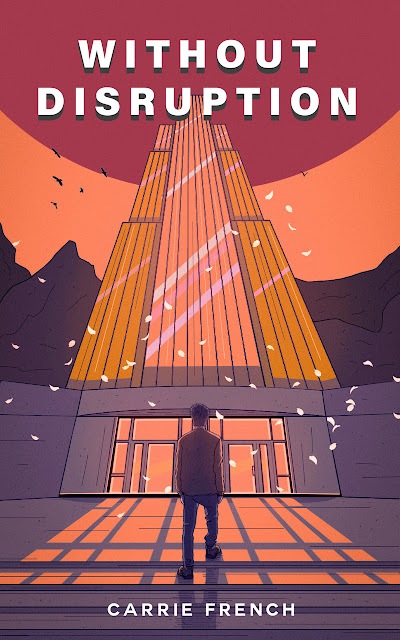
Without Disruption by Carrie French


Release date: January 10, 2022
Subgenre: Dystopian science fiction

About Without Disruption:


In pursuit of a different life, Harrison leaves everything behind – his family, his community, and even his own name. He can never go back.

Global society is united with a simple guarantee: everyone can achieve stable, lasting happiness for one hundred years in a curated lifestyle that brings them joy. Well… not unlimited joy, just mild contentment. No more, no less.

Every element of life is controlled by Vie – an AI system that is worshipped as divine. She guides members into ‘harmony’ with in-ear alerts, retina screens, and vast, immersive simulations.

Harrison is ambitious and impulsive with a curious habit of recalling hazy memories that never happened. The course of his life is punctuated with hasty decisions, emotional compromises, and genuine attempts to play by the rules.

He’s not only running out of options; he’s running out of time. Is Harrison’s will strong enough to break Vie’s authoritarian hold? Or will he finally learn to settle for mediocrity, just like everyone else?

The threat of ‘eviction’ is looming, and Harrison’s death day might come sooner than he thinks.

For fans of Alduous Huxley, Ray Bradbury, Lois Lowry, and Ira Levin, this thought-provoking dystopian novel sparks questions about the diversity of joy and the resilient fight for independence.


Excerpt:


I looked down at my naked body and saw the mangled threads of discolored flesh — all that remained of my scorched arm. Swallowing back the rising bile in my throat, I stood up and began to spin my attention around the room. My search for a door kept my attention away from the injury.

I was nearly sick again from the thought of it.

“During process, you will feel no pain.” Vie’s voice echoed and filled the small, square room, which was sealed with glossy white metal on every surface.

I didn’t feel any pain. I also didn’t physically feel anything at all. My breath didn’t blow across the tiny hairs inside my nostrils. The bottom of my feet didn’t make sensory contact with the floor. Was I dead?

I rotated again with dizzy unease. I couldn’t make sense of what I was really looking for. An exit? A distraction?

“You have reached the end of this lifecycle, but you will start again.”

The voice sliced through me and dragged a helpless chill down my spine. It explained a condensed version of everything I already knew and laid out the web-like pattern of a soul’s lifecycle. The speech droned on, fading numbly into the background of my awareness.

I no longer knew if I believed any of it, but I hoped it was true. I prayed to Vie, the system, or whatever this really was. This couldn’t be the end for me.

“Harrison, you did not find harmony in this cycle. In harmony with time and for the sake of all humanity, you must move forward without disruption.”

This exact same phrase had played out thirteen times over the course of my life, but never like this… For the first time, Vie’s timbre was ice cold, and it wasn’t posed as a question.

“The system is designed to carry memories forward through your final transfer. In order to preserve and save this evidence for future reflection, you may dictate a record of your experiences. When you are finished, speak the phrase, ‘Process my soul into the next cycle.’”

I stood in dazed silence until the stillness was broken by another message. With uncaring persistence, she echoed the script word for word.

How long do I have left? How long can I survive in here?

Vie repeated the message three more times, but I didn’t know how to respond.

My first instinct was to work out a plan and force my will toward a solution, but I was emotionally drained, enervated, and completely exhausted. There was nothing left to do.

As instructed, I recounted the story of my life — first hesitantly, then settling into a rhythm of remembrance.

“I had a pretty normal childhood… and, um, yeah… some experiences stand out… but everything worth remembering really set into motion on the day of my seventeenth birthday. That was the first time I had harmony in my grasp and mindlessly threw it away…”


Amazon | Website | Audible


About Carrie French:


Carrie French was born and raised in Oregon under a perpetually cloudy sky. It rained while she wrote her first book Without Disruption too. She has nearly a decade of experience as a freelance copywriter, and she writes for brands around the world. You’ve probably read her work while shopping online, but you’d never know it. (Funny how marketers don’t get a byline...) Carrie also enjoys playing the oboe, sipping whiskey, filming YouTube videos, and going on long runs through the countryside.


Website | Facebook | Twitter | Instagram | Goodreads | Bookbub | YouTube | TikTok